

What should News Futures
Build next?
The next cycle of News Futures Working Groups, Communities of Practice, and Gardening Club seats are now open — Here’s how to make proposals and nominations.
News Futures Charter Signatories like you shape our community’s priorities. Everything you need to participate in our field-building work is below.
Key Dates:
April 2026 — Working Group proposals, Community of Practice proposals, and Gardening Club nominations open
May 1 — Proposals and nominations due
By mid-June — All selected groups and members notified
By mid-September — All groups launched; Gardening Club terms begin
Submission Forms:

What we’re building together
News Futures started with an invitation.
In 2018, a small group of local news and civic media practitioners gathered in Detroit around a simple question: What if the people doing this work decided together where it should go? That gathering built lasting relationships. It became 20+ peer-led working groups. It became five years of an annual convening called FLN Camp. It became a Charter that hundreds have signed on to. Now it's a growing, peer-led community.
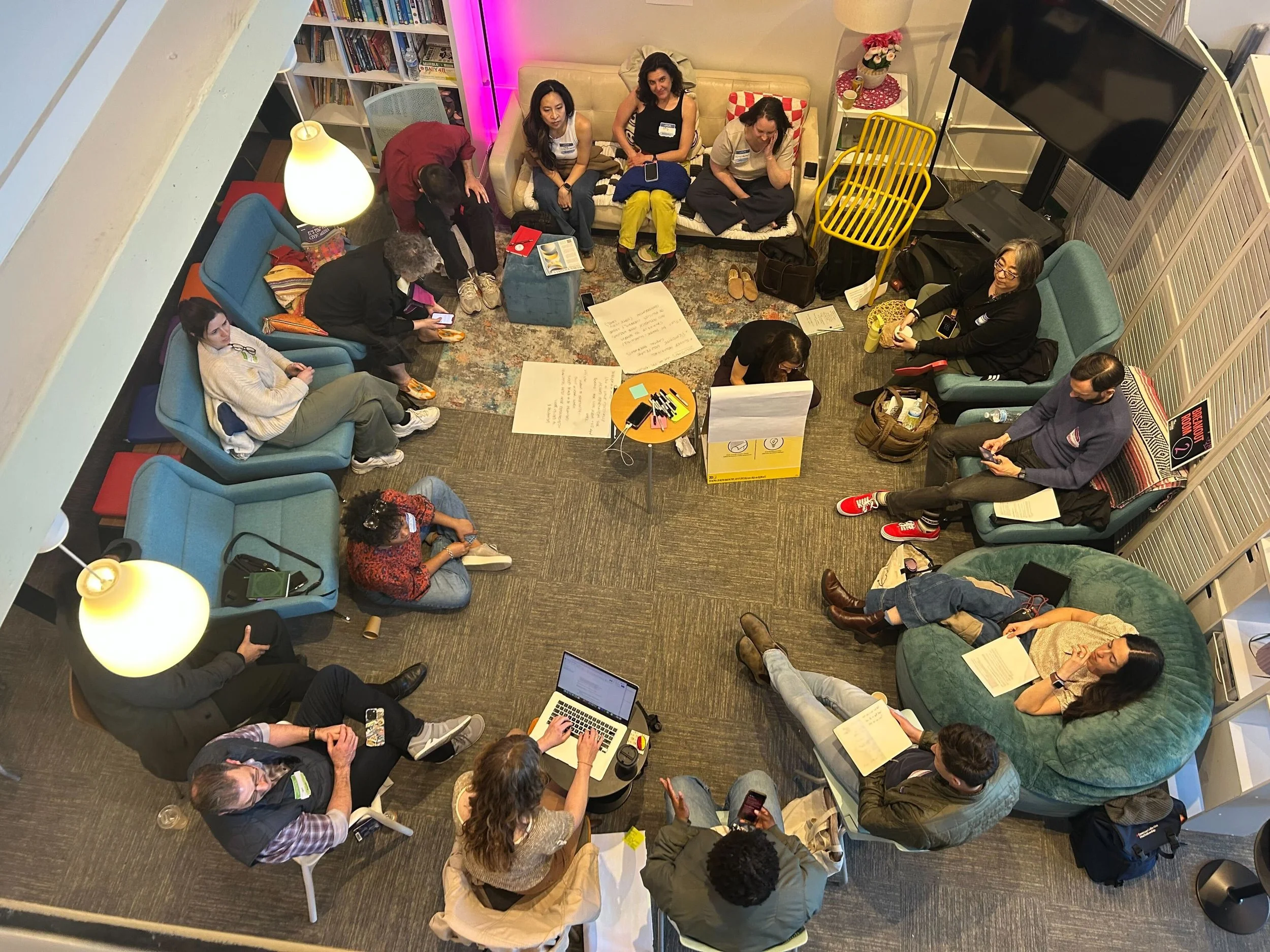
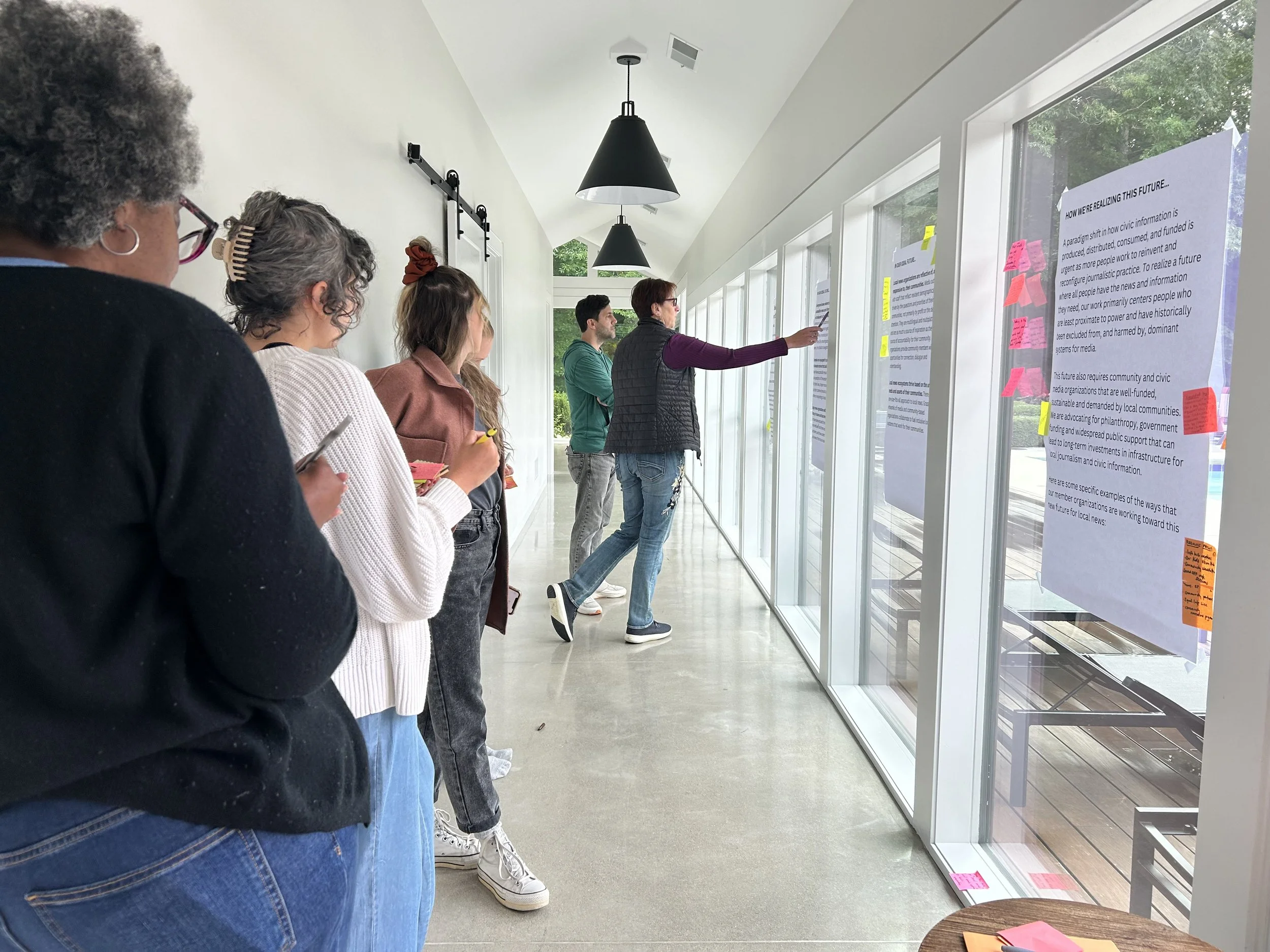
At the first News Futures Convention in March 2026, we convened 80 people in San Francisco. That included members of our Gardening Club and staff who help steward this organization; Working Group Stewards and Contributors who are the engine of our actual work; Signatories from local community-first outlets and major national organizations; long-time funders who are also genuine strategic partners; and cross-sector guests whose work touches civic information from adjacent fields.
It added up to three days together, working through what it would take to reimagine journalism, building a field dedicated to civic information that is service-oriented, participatory, and reparative.
News Futures Working Groups have already made real progress — the Hierarchy of Information Needs framework, the groundwork for the Media Power Collaborative, the Care Collaboratory, the Civic Media Census, and the News Futures Cookbook, to name a few. The Convention pushed further as delegates developed, proposed, and presented a strategy organized across five campaign areas.
The Story of Us — a sticky-note timeline built in-person at the Convention and grown digitally at our quarterly News Futures Live gathering — traces this history in layers: When did you arrive to News Futures, what was going on when you arrived, and what keeps you involved in this community of practice?
That last question is the one we're asking as we open the 2026–2027 cycle: What will you help build?
The five campaigns below represent where the News Futures is headed, and where we’re best positioned to act. We're looking for Stewards ready to help us pull it off.
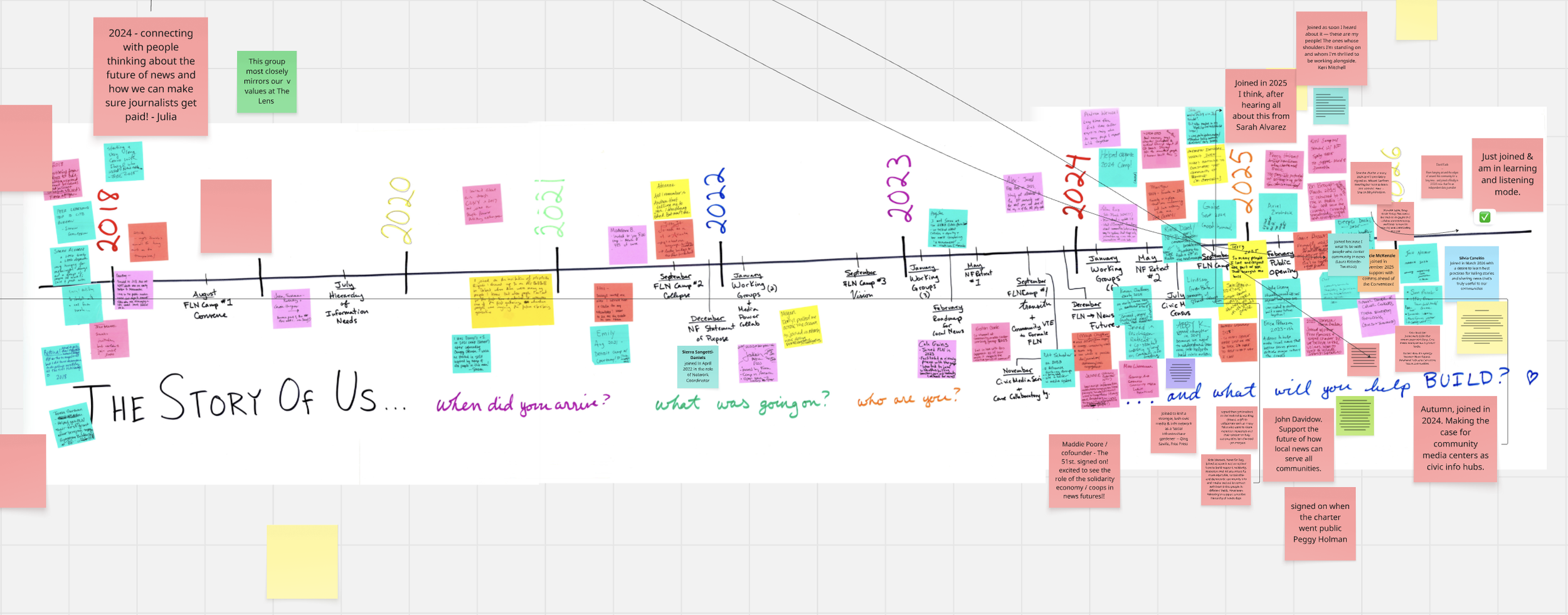
We started this timeline on paper at the first-ever News Futures Convention, then digitized it and added on at our virtual March 2026 News Futures Live gathering.
Our 2026–2027 Campaign Areas
Explore each campaign below. All Working Group and Community of Practice proposals should connect to one or more of these areas — all rooted in the Strong Field Framework.
-
What this campaign is about
Signing the Charter was the start — not the finish. This campaign invites Signatories to move beyond the moment of commitment and into sustained, visible participation. Through deepened engagement across Slack, Working Groups, the Gardening Club, and live events, we transform the Charter from a static document into a living guide that shapes how Signatories actually show up every day. The goal isn't more activity for activity's sake — it's building the kind of shared identity that makes this community feel like ours.
Sample Working Groups and Communities of Practice recommended by 2026 News Futures Convention proposals
Charter Review & Living Document: Focused on when and how the Charter gets updated — building a process for signatories to reflect on shared identity and ensure changes are reflected in the document itself.
Signatory Engagement Design: Dedicated to shaping what meaningful engagement looks like beyond the moment of signing — exploring how pillars like Slack, newsletters, and events deepen (rather than flatten) connection, and how new structures like peer-matching, mentorship and a “Welcome Committee” might expand our reach.
News Futures Live Programming: Develops sessions, formats, and content for live convenings — ensuring they build community, not just audience.
Conference Presence & Meetup Coordination: Helps signatories identify, plan, and host gatherings at conferences they're already attending — expanding our collective reach through existing travel.
-
What this campaign is about
The current funding and policy landscape boxes us in — because it was built without enough of us in the room and with less imagination than our vision demands. This campaign harnesses the collective people power, relationships, and influence of the News Futures network to open new doors: in policy, in private capital, and in philanthropy. When a policy window opens, we move together. When a new funding model deserves a real test, we prototype it. When funders need to see what's possible, we help them see it. Our power is in our coordination — and this is where we use it.
Sample Working Groups and Communities of Practice recommended by 2026 News Futures Convention proposals
Policy Monitoring & Response: Tracks relevant policy windows and coordinates collective action — building the infrastructure to swarm when a moment calls for it and ensuring our values are represented in policy conversations.
Private Capital Experimentation: Identifies, designs, and prototypes new revenue and investment models — testing what's possible when private capital is aligned with civic purpose rather than extraction.
Allied Funders Coordination: Maps and organizes philanthropic partners who share our values — creating the conditions for funders to act together, not in silos, and expanding optionality for the whole field.
-
What this campaign is about
The questions shaping civic information — about trust, sustainability, community need, journalistic practice — are being studied in pieces, scattered across disciplines, funders, and fields. This campaign builds a shared commons: a living, AI-accessible repository of the research and knowledge that matters most to our work. When the knowledge exists, we surface it. When it doesn't, we fund and steward the collaboration needed to create it. The Knowledge Base belongs to all of us — and we build it together.
Sample Working Groups and Communities of Practice recommended by 2026 News Futures Convention proposals
Knowledge Curation & Commons: Builds and maintains a shared repository — sourcing academic research, white papers, field research, and organizational learning docs, and making them accessible through AI-assisted tools with a process for ongoing updates.
Research Agenda-Setting: Brings together practitioners and researchers to define the key questions the field can't yet answer — laying the groundwork for the collaborations and funding needed to pursue them.
Researcher–Practitioner Collaboration: Actively bridges researchers and practitioners — creating ongoing channels for knowledge exchange, co-inquiry, and mutual accountability between those who study civic information and those who do it daily.
Research Translation & Dissemination: Turns findings — new and existing — into accessible, usable knowledge for the stakeholders we need to move: policymakers, funders, community members, and news organizations themselves.
-
What this campaign is about
Ideals don't implement themselves. This campaign builds the practical infrastructure Signatories need to bring Charter values into daily operations: self-assessments, recommended practices, model policies, ethical frameworks, and curricula — developed with the people who will actually use them. We're not creating standards for compliance. We're building scaffolding for growth, accountability, and genuine alignment. Because we only become what we aspire to be when aspiration meets real practice.
Sample Working Groups and Communities of Practice recommended by 2026 News Futures Convention proposals
Self-Assessment Tool Development: Builds a shared instrument for news and information organizations to evaluate their own alignment with our Charters’ values — designed to be honest, useful, and not punitive, with attention to both organizational and individual levels.
Recommended Practices & Model Policies: Produces practical, field-tested guidance — surfacing what's actually working across member organizations and translating it into replicable frameworks, model policies, and guides for different constituencies.
Ethics Code: Drafts a shared ethics code grounded in Charter values — one that grapples honestly with the tensions between org-level and individual accountability, and between internal culture and external standards.
Popular Education & Curricula: With fun as a design principle, develops learning resources that make the value of civic information tangible for practitioners, communities, and stakeholders who aren't already believers.
-
What this campaign is about
Across neighborhoods, counties, and communities, there are people doing the quiet, essential work of civic information and connection: block captains, community organizers, local journalists, neighborhood correspondents, and information stewards of every kind. They often don't know each other — and they rarely know us. This campaign maps, connects, and resources that work, building bridges between News Futures Signatories and the grassroots infrastructure that civic life depends on. The goal isn't to absorb these communities into our community — it's to show up for theirs.
Sample Working Groups and Communities of Practice recommended by 2026 News Futures Convention proposals
Community Information Stewardship Mapping: Identifies, documents, and connects local anchors, weavers, and connectors doing civic information work — building a living map of the infrastructure that holds communities together and revealing where resources and relationships are most needed.
Info Steward Dinners: Enables and supports News Futures members to convene neighborhood correspondents, block captains, community organizers, and local journalists in their own contexts — building the habit of gathering and the solidarity that follows.
Charter Translation for Community Work: Translates Charter values and language into frameworks that resonate with community-level practitioners — county workers, organizers, faith leaders, neighborhood correspondents — who are doing this work outside traditional journalism.
Popular Education Toolkit: Develops practical resources for making the case for civic information at the community level — tools that local information stewards can actually use to educate, organize, and build public will.
How to Get Involved
News Futures runs on the energy of people who want to do more than stay informed — they want to shape the field. For the 2026–2027 cycle, there are three primary ways to engage, each designed for a different kind of contribution and level of commitment.
These aren't silos — our campaigns designed to talk to each other and cross-pollinate. Working Groups produce knowledge that Communities of Practice can explore. Communities of Practice may evolve into Working Groups. Elected staff and Gardening Club members shape the conditions that make all of it possible. Participation in any of them is a genuine contribution to the News Futures “do”-ocracy.
Expand each guide below for full information on eligibility, structure, funding, selection process, and how to apply. Proposals and nominations for all three open in April 2026.
-
What Is a Working Group?
Working Groups bring together a small, committed team to tackle a specific challenge or opportunity within one of News Futures’ five campaign areas. Each group has a clear scope, a defined timeline, and the resources to do meaningful work — not just talk about it. Groups typically run on 15-month cycles, but must conclude by December 2027.
Who Can Participate?
Working Groups are open to current News Futures Stewards and 2025–2026 Working Group Contributors — anyone who has participated in a Working Group to date. Each group has one primary Steward who holds the contract and leads the work; co-leads and additional team members are welcome.
See if you’re eligible to submit a 2026-2027 Working Group proposal.
How It Works
The primary Steward is responsible for coordinating contributors, with hands-on support from a dedicated News Futures staff member throughout the cycle. Groups operate with regular check-ins, clear deliverables, and a monthly or bi-monthly payment cadence. We’re limiting this cycle to fewer than five groups to ensure each one gets the support it deserves.
Funding & Support
$25,000 per group (budget determined by the primary Steward, approved by News Futures staff)
Access to News Futures design, editing, and operational support throughout the cycle
A dedicated News Futures staff member supporting these groups
Monthly or bi-monthly payment cadence
What Makes a Strong Proposal?
A strong proposal will have a clear connection to one of News Futures’ five campaign areas, a defined scope and deliverables, and a Steward with the capacity and commitment to lead the work. You don’t need to have everything figured out — but you should have a clear sense of the question you’re trying to answer and why it matters to the field.
Key Dates
April: Proposals and nomination open
May 1: Submissions due
By Sep 15: Working Groups launch
Dec 2027: Cycle closes
Selection Process
Proposals open in April and are due May 1.
Gardening Club and staff review all submissions. Proposals that align with strong dot voting from the 2025 Convention — which captured both what attendees found most pressing and what felt most ripe for action now — will be weighted favorably in this review.
All submissions go to the News Futures community for a vote.
Staff make the final selection based on operational capacity and strategic alignment — with Gardening Club input and community votes strongly considered.
How to Apply
Complete the Working Group proposal form, linked at the top of this page. Submissions are reviewed by News Futures staff with final selections informed by the Gardening Club and a community vote.
-
What Is a Community of Practice?
A Community of Practice is a gathering space for people who are curious about the same questions. Communities of Practice run in cohorts up to 15 months (ending by December 2027), meeting at least monthly around shared themes tied to NF’s campaign areas. They’re lower barrier and higher flexibility than Working Groups, but no less valuable — a genuine contribution to the field, not a waiting room.
Who Can Participate?
Communities of Practice are open to any News Futures Signatory. No prior Working Group participation required.
See if you’re eligible to submit a 2026-2027 Working Group proposal.
How It Works
Each Community of Practice has a Steward who holds the container: facilitating monthly gatherings, connecting members to News Future’s campaign goals, and helping the cohort produce something meaningful by the end of the cycle. Cohorts may run for any length of time but must conclude by December 2027.
Stipends & Support
Stipends up to $2,500 based on scope (budget determined by the primary Steward, approved by News Futures staff)
Access to News Futures operational support throughout the cohort
Support from News Futures staff
What Makes a Strong Proposal?
A strong Community of Practice proposal identifies a genuine question or thread worth exploring together, names a clear connection to one of News Futures’ five campaign areas, and has a Steward ready to facilitate with care. You don’t need a pre-formed cohort — News Futures will help connect interested members once groups are confirmed.
Key Dates
April 1: Proposals and nominations open
May 1: Submissions due
By Sep 15: Cohorts launch
Dec 2027: Cycle closes
Selection Process
Proposals open in April and are due May 1.
Gardening Club and staff review all submissions. Proposals that align with strong dot voting from the 2025 Convention — which captured both what attendees found most pressing and what felt most ripe for action now — will be weighted favorably in this review.
All submissions go to the News Futures community for a vote.
Staff make the final selection based on operational capacity and strategic alignment — with Gardening Club input and community votes strongly considered.
How to Apply
Complete the Community of Practice proposal form, linked at the bottom of this page. Submissions are reviewed by News Futures staff with final selections informed by the Gardening Club a community vote.
-
What Is the Gardening Club?
The News Futures Gardening Club is an elected strategic committee for people drawn to the long view, helping keep News Futures work focused on and accountable to the News Futures Charter. This group does this by thinking through strategic questions, providing high-level feedback on major activities, and signaling emerging needs.
The group's contribution is scoped to specific areas of work based on where its insight is needed most. Sometimes that’s defined by Gardening Club, and at other times by News Futures Staff.
To get a sense, the first strategic question Gardening Club addressed was whether and how to scale News Futures participation. That led to what we now know as the Charter. In 2025, we developed a strategy for News Futures’ convenings to best help achieve the vision that was outlined, which led to a “Convention” event model and smaller meetups throughout the year.
Gardening Club is not a formal governing board. It exists to support, not direct, staff. But we are responsible for certain types of approvals and administrative work. Check out the General Responsibilities below.
News Futures is seeking up to four (4) members to join the Gardening Club. Individuals who are elected will serve a two-year term, beginning June 2026 and ending May 2028.
Who Can Run?
Any current News Futures Steward or Contributor (Working Group participant) can be nominated to join the Gardening Club.
Caveat: Though you can be nominated, anyone leading a Working Group beyond June 1, 2026 will not move forward in this process.
🔗 Click here to see the list of stewards and contributors eligible to join
We limit nominations to these roles to ensure whoever joins has experience working with News Futures and has a general understanding of its core work. If you are a Signatory but have not yet participated in a Working Group, we recommend getting involved in the next round so you are ready to be nominated in the future.
What We're Looking For
We’re aiming to build a Gardening Club with a well-rounded mix of perspectives, skills, and experience. To do that, there are some specific qualities that we are looking for to help balance the strengths of current members and bring expertise that will be important as they work on upcoming strategic work.
We’re looking for people with some (not necessarily all) of the following experience:
A professional with a background outside of journalism who can bring a fresh perspective
Independent contractors or freelancers who understand the challenges of self-directed work
Leaders with succession planning experience or who have guided organizations through leadership transitions
Operations-focused professionals skilled in scaling operations and resource allocation
Strategic thinkers who excel at connecting dots, seeing patterns, and synthesizing information across different areas
Your special sauce!
One Hat, One Head
Anyone leading a Working Group beyond June 1, 2026 will not be able to serve as a member of the Gardening Club. We follow the "one hat, one head” rule and are looking to spread power and leadership influence across News Futures to as many people as possible.
This is important to note because the period for identifying new Working Groups will overlap with this election process. If you're interested in both opportunities, we encourage you to pursue both as they arise. However, if it happens that you are nominated for the Gardening Club and also selected to lead a Working Group, you will need to choose which role you will pursue. We want to spread the love.
If you are simply participating in a Working Group (not leading it), this caveat does not apply to you. You will still have a chance at being elected to join the Gardening Club.
Current Members
Adrienne Johnson Martin
Cassie Haynes
Courtney Lewis
Darryl Holliday, News Futures Lead Steward
John Davidow
Mazin Sidahmed, Co-Chair
Lizzy Hazeltine
Sonam Vashi, Co-Chair
Selection Process
Eligible to join — Current News Futures Stewards (Working Group leaders) or Contributors (Working Group participants).
Nominations (April through May 1) — Stewards and contributors can nominate up to one person. You may nominate yourself or someone else you think would be a great candidate.
Gardening Club creates a slate (May 1 to May 24) — Current Gardening Club members review nominee entries and create an election slate of at least five (5) individuals, based on the needed skills and expertise.
Stewards vote (May 25 to June 5) — Stewards will vote, and nominees with highest votes will be elected to join Gardening Club.
Term begins (June 15)— New Gardening Club members begin their two-year team through May 28, 2028.
How to Nominate
Nominations can be submitted by any current News Futures Steward or Contributor — each may nominate one person, including themselves. Submit using the Gardening Club Nomination Form by May 1, 2026.
Current Gardening Club members will then create an election slate of at least five candidates; stewards vote May 25–June 5.
Questions? Reach out to Adrienne (adrienne.martin@mlk50.com) or Courtney (courtney@inn.org).
Ready?
Submit Your Proposal or Nomination Below
All three forms open in April 2026.
Deadline for all submissions is May 1.
Questions? Join one of our online info sessions—register below:
Community of Practice Proposal
Steward name & email
Are you a current News Futures Signatory?
Community of Practice name / working title
Which campaign areas does this connect to?
What question or thread will this Community of Practice explore?
What does a meaningful outcome look like?
How long do you envision the cohort running?
Do you have a sense of who might participate?
Requested stipend (up to $2,500)
Are you also submitting a Gardening Club nomination?
Working Group Proposal
Primary Steward name & email
Are you a 2025 News Futures Steward or Working Group Contributor?
Working Group name / working title
Which campaign areas does this connect to?
What challenge or opportunity will this Working Group address?
What are your proposed deliverables?
Who else is involved?
How would you use the $25,000 budget?
Are you also submitting a Gardening Club nomination?
Gardening Club Nomination
Full name
Email address
Current role / organization
Are you a 2025 News Futures Steward or Working Group Contributor?
Why are you interested in serving on the Gardening Club?
What perspective would you bring that isn't yet represented?
Are you also submitting a Working Group or Community of Practice proposal?
Anything else you'd like us to know?
Full TimelinE
2026 Launch and Engagement
From now through September 2027, here's how everything unfolds:
-
All participation forms go live; Interest sessions hosted for prospective Working Group, Community of Practice, and Gardening Club participants throughout April; questions welcome via the News Futures Slack
-
Gardening Club nominations, Working Group proposals, and Communities of Practice proposals all due
-
Proposals reviewed; News Futures community votes on Working Groups, Communities of Practice, and Gardening Club members
-
All selected groups and members notified and confirmed
-
Onboarding period (~10 weeks) for all selected Working Group stewards, Community of Practice leads, and incoming Gardening Club members
-
All Working Groups and Communities of Practice active and open to Signatories; Gardening Club terms begin
-
Working Groups and Communities of Practice active (~15 months)