

Towards a Holistic and Actionable Theory of Public Interest Journalism
Reflections From the Information Hierarchy of Needs Working Group
By Sarah Alvarez and Harry Backlund
This white paper was produced through the News Futures Hierarchy of Information Needs Working Group.
Context
Six years ago, a small, informal working group of journalists and local media organizers gathered to confront journalism’s lack of a theory of change. We summarized those conversations in a series of writings, starting with a 500-word essay titled “Is Your Journalism a Luxury or a Necessity?”
The argument was straightforward: huge amounts of attention and money go towards journalism that serves the needs of a relatively small elite. This creates an inequitable information ecosystem that ignores what people need to know to access fundamentals like housing, food, safety and economic security. This approach is unsustainable, and incompatible with the democratic ideals journalism is supposed to serve. There is huge transformative potential in a structured approach that treats the infrastructure for meeting basic information needs as an essential public utility. Borrowing from Maslow, we proposed that an “information hierarchy of needs” could help us reorient our priorities as individuals and as a field.
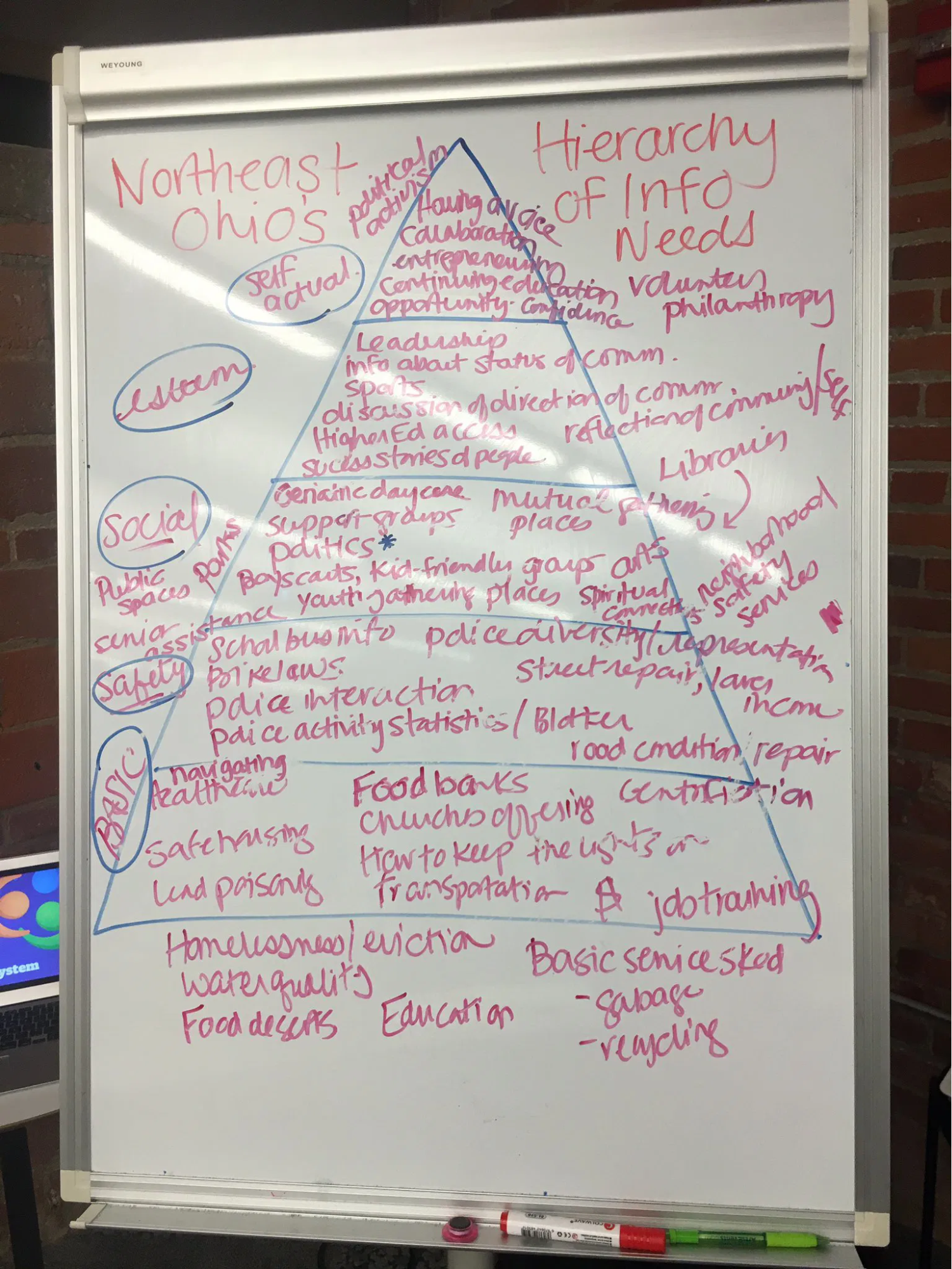
The piece—published as a short blog on City Bureau’s website in 2019—circulated far more widely than we expected. It was shared in national newsletters, incorporated into journalism school curriculums and, most importantly, used in local workshops around the country, where people brainstormed and then mapped the information needs of their own communities. It helped to stir important conversation about what journalists prioritize, and how our practices should evolve.
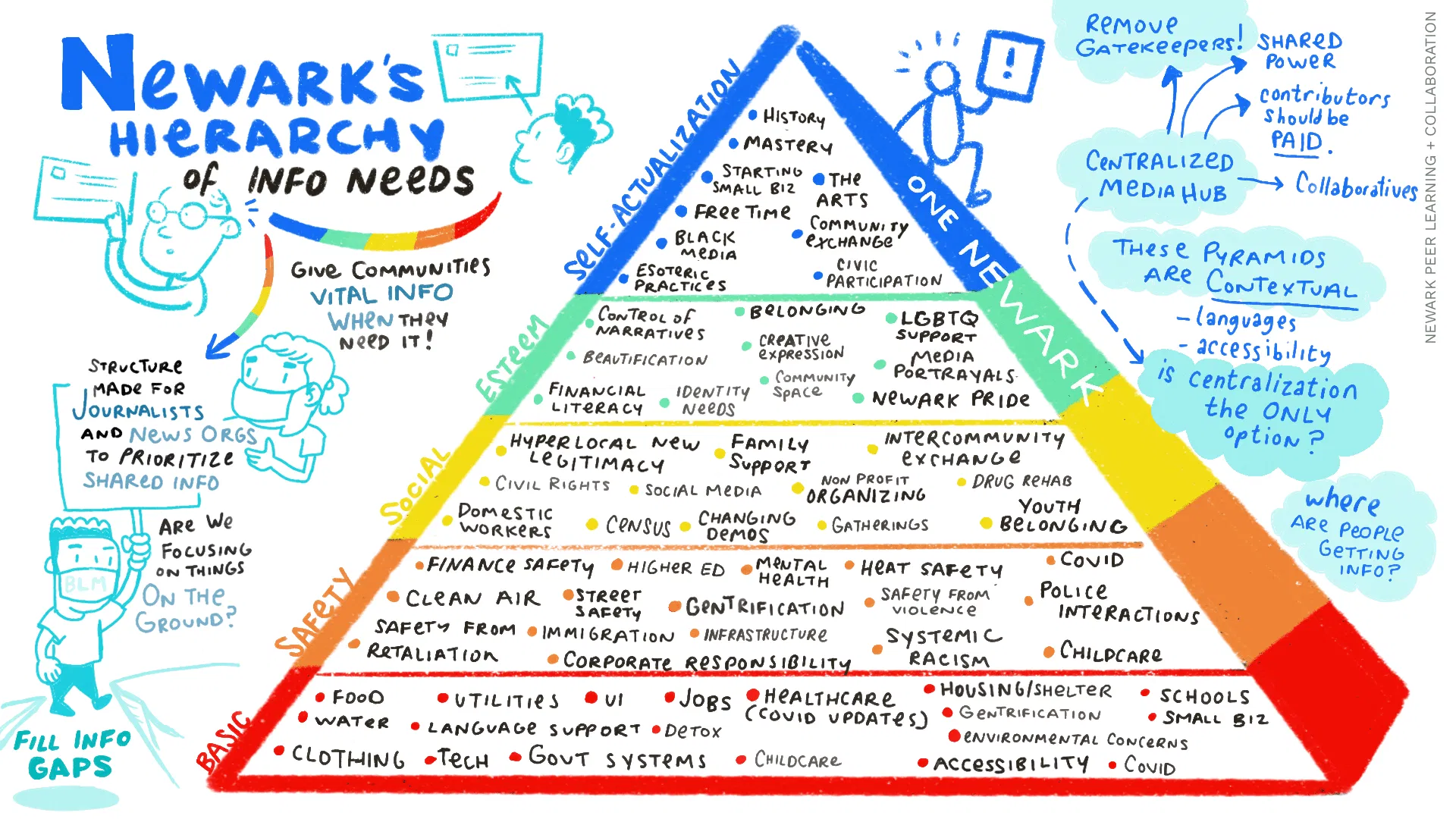
Hierarchy of information needs exercises from community workshops in Newark, NJ and Northeast Ohio (Center for Cooperative Media)
In the years since that piece was published, we have lived through a global pandemic, an ongoing affordability crisis, and the rise of an authoritarian political movement that exploits misinformation as a political tool while twisting the knife on journalism’s class problem to discredit the very idea of public truth. Meanwhile, critical journalism infrastructure writ large has continued to collapse, and conversations about the field’s future still have not fully squared with the underlying market failure. Most of the policy proposals in play would prop up or reinforce the status quo, instead of creating a framework for a more accessible and equitable information paradigm.
Yet even as the need for a structural approach has never been more relevant, the framework of a “hierarchy of information needs” is insufficient. It served its purpose in sparking critical conversations about journalistic priorities, and can be a useful and intuitive tool for mapping collective information needs. But it does not offer paths to identify and then meet those needs. The hierarchy of information needs clarifies the problem. What tools would need to actually solve it?
How We Organized and What We Did
To get closer to an answer, we organized a New Futures Working Group to reevaluate the information needs framework. We wanted to go beyond the original napkin-sketch of a model towards a more nuanced and actionable theory of information needs, one that could help journalism better live up to its promise as an essential public good in a pluralistic democracy.
Forty-eight journalists, media workers and academics signed up. We gathered in regular conversations every month or two, and also broke off sub-groups focused on basic information and connective social information needs, as well as a reading group focused on the intellectual history of information needs—how people in other times and places approached serving the connective information needs of a democracy.You can find the results of our research and conversations in this living syllabus, focused on a series of key questions, including “What are the information needs of a democracy?” and “What does ‘the public interest’ actually mean in a democracy?" The syllabus is not comprehensive or authoritative, but it offers a record of the threads we followed in this process, and a jumping-off point for further conversations.
The questions we were interested in spanned the partially-connected edges of many fields of study: media studies, journalism, economics, sociology and product design, among others. Unlike, say, public health, there is no specialized field examining the health of civic information and its impact on democratic deliberation. This is a first pass at centralizing those conversations, and the medium of a syllabus is intentional. What should be covered in “Approaches to Public Information Needs 101?”
We also hope that, looking forward, journalism will take more seriously its function as popular political education, and that individual journalists will take the lead on that work. We who have experienced the fundamental contradictions of journalism in a democracy have real power to reimagine the field as a public good. That can start by thinking critically and constructively about our own practices.
Reflections
Our group’s conversations were wide ranging, and this first draft of the syllabus includes 15+ readings covering many themes that could move us closer to a healthier theory of public interest journalism.
We anticipate three particularly shaping our work going forward:
Economic, political and social forces have always complicated journalism's ambition to serve the public interest.
An honest look at the complicated incentives driving news production can help us cut through journalism’s professional mythology to understand the field’s actual value(s)—and identify how best to produce and sustain high-value work.
James Hamilton's work was especially valuable in describing information as an economic good and illustrating how commercial news coverage is determined by who cares about information, what advertisers will pay to reach them and when it's profitable to provide it. Hamilton examines whether journalism's civic ideals can survive in a marketplace that systematically underproduces the information democracy requires. What kinds of information needs can the market meet, and how do we define the value of the socially necessary ones that it can't?Information alone does not make an informed community—that requires social relationships that generate and maintain trust in accepted facts.
A major limitation of the original “hierarchy of information needs” framework is that by flattening broad categories of information need, it obscures the fundamentally social nature of how information is produced, exchanged, validated and acted upon.
Communication Infrastructure Theory offers a correction. Developed by Sandra Ball-Rokeach based on her work in multi-ethnic Los Angeles neighborhoods, CIT analyzes how information flows through layered storytelling networks of residents, community organizations and local media. As Working Group member Nina Weingrill summarized in a dissertation that used CIT to analyze Brazil’s 2024 Porto Alegre floods: “Information becomes usable and empowering only when it is perceived as credible and embedded within trusted social frameworks.”
CIT posits that distributed networks of personal trust enable communities to produce, share and make sense of information. This suggests that the journalistic goal of creating “informed communities” through accurate reporting may reverse how the process actually works; strong communities yield healthy information conditions to a greater degree than good information creates strong communities. If this holds true, journalists must treat community building as not merely an engagement strategy but also an essential ingredient to journalism itself. Without community, information may have nowhere to land.
CIT also offers analytical tools to more consistently describe, map and quantify this infrastructure of connectivity—tools that could be extremely useful for assessing journalism’s ability to meet information needs in actual practice.The social ambitions of journalism have been built on insufficiently rigorous ideas of collectivism.
Broad gestures toward collective interest appear constantly in journalism discourse but remain vaguely defined. “Community” is real but complex and layered, made up of as much conflict as continuity, in ways journalism has not always accounted for. For journalism to fulfill its promise as a pillar of multicultural democracy, it must engage more rigorously with conflict, difference and competing interests. As Myria Georgiou titled her study of ethnic media and neighborhood identity in London, “conviviality is not enough.”
The concept of “public interest” suffers from similar vagueness. In both journalism and—to our surprise—law, it has not been defined with rigor. The prevailing operational definition treats public interest as the aggregate of everyone's distinct private interests; if it interests a critical mass of individual members of the public, it must be in the public interest.
The legal scholar Eric R. Boot offers an alternative that points toward more productive journalism practice. Boot distinguishes between interests of the public (what people happen to care about) and interests people hold in their capacity as members of the public—interests they share by virtue of living in a polity together. A parent's interest in their own child's school funding is a private interest; their interest in an educated citizenry capable of democratic participation is a public interest. Private interests can be satisfied individually, while public interests by definition require collective action and shared institutions.
This distinction has profound implications for journalism. What would it look like to build toward serving people as members of the public, rather than simply aggregating what already interests them as private individuals? How can journalism advance the interests we can only realize collectively?
How You Can Contribute to the Conversation
This is a first draft of what we hope will be a living resource, and you are invited to participate, critique and help build it! If you've read something that pushes journalism toward becoming an essential public good, we encourage you to suggest additions using this form. Contributions from our community have already pushed our conversations in new directions, which you’ll see added to the syllabus over time.
Our ultimate goal is to build a collection of readings the News Futures Community can turn to for clarity, inspiration or provocation as we collectively navigate how to define and serve this essential public good.
Sam Cholke, Hosam El-Nagar, and Andrea Wenzel contributed sources and notes to the original bibliography. As the syllabus evolved, other contributors may be noted in the Airtable base above.